01 · The basics
What does GS1 Sunrise 2027 mean?
GS1 is the not-for-profit global standards organization behind the barcodes on almost every product sold in stores, including the UPC in North America and the EAN in Europe and many other regions. In Canada, the GS1 member organization is GS1 Canada.
In barcode industry language, a “sunrise date” is the point from which a change is expected to be supported. Sunrise 2027 is the plan, set by the retail industry in collaboration with GS1, for retail checkout systems to be ready to read 2D barcodes in addition to the barcodes they read today.
The first step asked of a checkout is modest. It needs to scan the 2D barcode and extract the product’s GTIN (Global Trade Item Number), the number that identifies the product, in the same way it does with a traditional barcode today. GS1 US notes that retailers do not need to implement every capability of 2D barcodes by that date; more can be added over time.
02 · Why it’s changing
Why is the industry moving to 2D barcodes?
The barcode on most packages was designed in the 1970s to do one thing: identify the product at the checkout. A traditional 1D barcode holds a product number and very little else.
Shoppers, retailers and regulators are all asking for more product information than that. A 2D barcode holds far more in the same space, so a single code can do several jobs at once:
Better information for shoppers
A web link lets a shopper scan with their phone camera and reach product details, ingredients and allergen information, safety alerts, recycling guidance and offers, none of which fit on a printed label.
Faster, more targeted recalls
A batch or lot number in the code means a recall can focus on the affected lots instead of a whole product line, and a recalled item can be flagged at the checkout so it is not sold. This depends on the lot data being connected to the right systems.
Less waste, fresher shelves
An expiry or best-before date in the code lets retailers sell or promote products nearing their date first and rotate stock more accurately, so fewer expired items are thrown away.
Traceability and authentication
Batch, lot and serial data help brands and retailers follow products through the supply chain, and serial numbers can help confirm that a product is genuine.
Shoppers are interested in this. GS1 US reports that a 2025 consumer survey found that 79% of consumers are more likely to buy a product that has a scannable QR code giving them more information.
03 · Comparison
1D barcodes vs 2D barcodes.
A traditional barcode holds a product number. A GS1-enabled 2D barcode holds that same product number and can carry more, including a link a shopper can open with their phone.
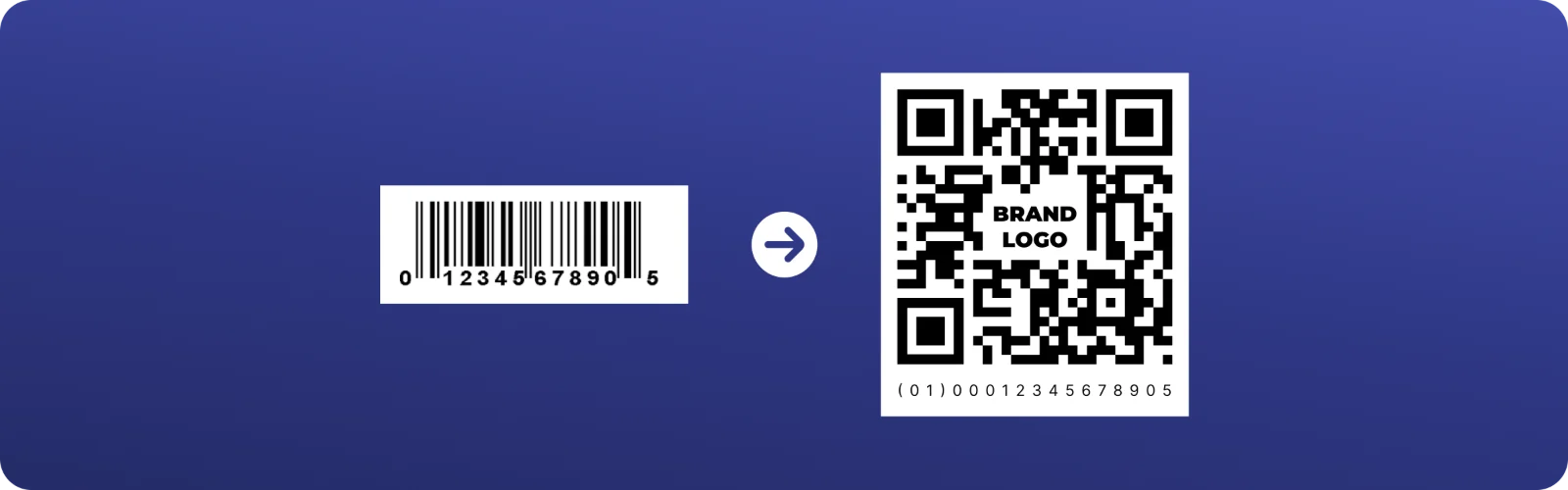
| Traditional 1D barcode | GS1-enabled 2D barcode | |
|---|---|---|
| Examples | UPC, EAN | QR Code with GS1 Digital Link, GS1 DataMatrix |
| What the code contains | The product number (GTIN) only | The GTIN plus extra data such as batch or lot, dates and serial number |
| After the pack is printed | Nothing to update | The page a link points to can be updated without reprinting |
| Scanned on customer’s phone | Not designed for phones | A QR Code with GS1 Digital Link opens a web page from the phone camera |
| Scanned at checkout | Read by laser or camera scanners | Read by imaging (camera-based) scanners and software that can process it |
| Status in Sunrise 2027 | Keeps working; not being removed | The format checkouts are being prepared to read |
04 · The technology
What is a GS1-enabled 2D barcode?
Not every 2D barcode qualifies. A QR code that simply holds a website address is not a GS1-enabled 2D barcode. To work at the checkout, the code has to follow GS1 standards so a scanner can find the product number inside it. GS1 recognizes three types:
QR Code with GS1 Digital Link
The type that can serve both the checkout and shoppers. It looks like any other QR code, and the default camera on virtually all modern smartphones can scan it and open a web page.
Customer interaction on mobileData Matrix with GS1 Digital Link
A DataMatrix that carries the web-link format. It can connect people to the web, but not all phone cameras can read this type automatically yet, so it is not the usual choice for customers.
Limited phone support currentlyGS1 DataMatrix
A compact square code that holds product data but no web link. It is widely used across the supply chain and in healthcare, where the data is meant for systems rather than shoppers.
No customer interaction on mobileHow GS1 Digital Link works
GS1 Digital Link is the GS1 standard for building a web address around a product’s identity. The result is a normal web address, so a phone can open it like any other link, with the product’s number and, if wanted, extra details written into it. Here is an example of what is inside such a QR code:
https://brand.exampleWeb address/01/09506000134352Product number (GTIN)/10/LOT42Batch or lotOptional/21/12345Serial numberOptional?17=261231Expiry dateOptional- Web address (the base URL). Where a phone is sent. It can be the brand’s own site or a service like TapScan.
- Product number (GTIN). Identifies the product. It is the only part a checkout needs for the first step of Sunrise 2027.
- Batch or lot (optional). Identifies the production batch an item came from, which is what makes targeted recalls possible.
- Serial number (optional). Identifies one individual item.
- Expiry date (optional). Written as year, month, day (YYMMDD), so 261231 is 31 December 2026.
The short numbers in the link (01, 10, 21 and 17) are GS1 codes called Application Identifiers. Each one is a label that tells a scanner what kind of information comes next: 01 means a product number follows, 10 a batch or lot, 21 a serial number and 17 an expiry date. GS1 has more than a hundred of them, covering other kinds of data.
The extras follow the GTIN in a set order: batch or lot, then serial number (an optional product variant code, 22, comes before both when it is used). A checkout scanner ignores the web address and reads the product number. A shopper’s phone follows the link. The same printed code therefore serves two audiences.
What is inside the product number (GTIN)?
The GTIN is the same number that sits under a traditional UPC or EAN barcode. It is made of a few parts:
0Leading zero9506000GS1 Company Prefix13435Item reference2Check digit- GS1 Company Prefix. Issued by GS1 to the brand owner, so it identifies the company. Its length varies from company to company.
- Item reference. Chosen by the brand to identify each individual product.
- Check digit. Calculated from the other digits, so a typing or scanning mistake can be caught.
- Leading zero. Padding that makes every GTIN 14 digits long in the link. A 13-digit number gets one zero and a 12-digit UPC gets two.
How TapScan helps your brand enable the technology
TapScan creates branded QR codes using GS1 Digital Link and connects them to the right product identities and destinations, so the code on the pack can also lead to a product experience you control.
05 · Timeline
What is the GS1 Sunrise 2027 timeline?
Get ready
Retailers upgrade scanners and checkout software. Brands begin adding 2D barcodes to packaging, usually alongside the existing UPC or EAN (dual marking). Pilots and testing continue across the industry.
Checkouts are ready
GS1’s plan aims for retail checkout systems to be able to scan and process 2D barcodes. Readiness still varies from retailer to retailer.
More choice
Brands keep the traditional barcode next to the 2D barcode until about 90% of checkout scanning solutions can read GS1 2D barcodes. After that, brands can choose a 2D barcode on its own. It depends on checkout readiness, not a date on the calendar.
These dates are an industry target, not a legal deadline. Each retailer decides its own timing, so the most useful question for any brand is when the retailers it sells to expect to be ready.
06 · Who is affected
Who is affected by GS1 Sunrise 2027?
Brands and manufacturers
Plan to add a GS1-enabled 2D barcode to packaging. If you already print a QR code, GS1’s guidance is to update it to the GS1 Digital Link format and include the product’s GTIN.
Retailers
Upgrade or replace laser scanners with imaging scanners, and update scanner and checkout software so they can read the 2D barcode and use the data inside it.
Packaging printers and converters
Print 2D barcodes at a quality that scans reliably, and check them as part of production. Artwork and print specifications may need to change.
Technology providers
Checkout, inventory and product-data systems need to receive and use the new data. Brands also need a system behind the QR code that sends each scan to the right place.
07 · Common misunderstandings
What GS1 Sunrise 2027 is not.
- It is not the end of the UPC or EAN barcode. GS1’s plan does not remove it. Until about 90% of checkout scanning solutions can read GS1 2D barcodes, a product with a 2D barcode on its pack should also carry a traditional one.
- It is not a law. It is an industry timeline set by retailers and brands together with GS1. Retailers decide what they require from their suppliers.
- It is not only a checkout upgrade. The checkout is the first step. The larger opportunity is the extra data and the link to shoppers that 2D barcodes make possible.
- It does not mean any QR code will do. The code has to follow GS1 Digital Link and include the product’s GTIN.
- It is not a finished experience by itself. What a shopper sees depends on the information, systems and content connected to the product identity. For example, a QR code alone does not create product traceability: batch- or lot-related notices need the right identifiers and connected data behind them.
08 · Getting ready
How can a brand prepare for GS1 Sunrise 2027?
Most of the early work is groundwork you can start now, before anything changes on your packaging.
- Find out where your retail partners stand. Ask the retailers you sell to whether and when they plan to read 2D barcodes at the checkout, and whether they will ask suppliers to add one. Their timing sets yours.
- Take stock of your products. List every product you sell at retail and confirm each one has a correct GTIN. These are the same product numbers already behind your UPC or EAN barcodes, and they carry over to 2D barcodes.
- Check your GS1 membership and data. Make sure your GS1 membership is current and that the product details held against your GTINs are accurate and up to date.
- Talk to your packaging and print partners. Ask your printers and converters whether they can print and verify 2D barcodes at the quality scanners need, and when your next artwork or packaging changes are due. A planned redesign is the easiest moment to add a code.
- Decide who owns it and where to start. Bring brand, packaging, quality, supply chain and IT together, name one owner, and pick a small set of products to look at first.
What comes next
Once the groundwork is done, the bigger question is what the code should do for your customers. That is where TapScan can help.
How TapScan can help.
TapScan helps brands move from 1D barcodes to GS1-enabled 2D barcodes that also work as a connected experience.
- Create branded QR codes using GS1 Digital Link.
- Connect them to the right product identities and destinations.
- Direct each scan to relevant information based on the product and scan context.
- Measure engagement.
- Update content over time without reprinting packaging.
09 · Questions answered
GS1 Sunrise 2027: frequently asked questions.
GS1 Sunrise 2027 is a global industry initiative for retail checkout systems to be able to scan and process both traditional 1D barcodes and GS1-enabled 2D barcodes by the end of 2027.
It was set by the retail industry in collaboration with GS1, the organization that maintains the barcode standards used on products worldwide. The aim is that a product with a GS1-enabled 2D barcode can be recognized at the checkout in the same way a traditional barcode is today.
GS1’s plan aims for retail checkout systems to be able to scan and process 2D barcodes by the end of 2027. Retailers are moving at different speeds, so readiness varies from one retailer to the next. Brands are generally advised to start preparing before 2027 and to keep the traditional barcode on packaging during the transition.
Sunrise 2027 is an industry timeline set by retailers and brands together with GS1. It is not a government regulation. Individual retailers decide what they ask of their suppliers and when, so the practical answer depends on who you sell to. Some regulated sectors, such as healthcare, have their own rules for 2D barcodes.
GS1’s plan does not remove the traditional UPC or EAN barcode. During the transition, a package can carry both the traditional barcode and a 2D barcode (known as dual marking). GS1’s guidance says that until about 90% of checkout scanning solutions can read GS1-compliant 2D barcodes and capture the product number, a product with a 2D barcode on its pack should also carry a traditional barcode. Once 2D barcodes are widely supported at the checkout, brands can choose to use a 2D barcode on its own.
A regular QR code can hold any web address. A QR code that uses GS1 Digital Link follows a GS1 standard: the web address is built around the product’s GTIN (its Global Trade Item Number), so a checkout can pick out the product number while a shopper’s phone follows the link.
That is what lets one code do two jobs. A QR code that does not include the GTIN in the GS1 format is not a GS1-enabled 2D barcode.
A traditional barcode carries only the product number. A GS1-enabled 2D barcode can carry that number plus additional data, for example:
- Batch or lot number, so a recall can focus on the affected lots.
- Expiry or best-before date, so retailers can sell or promote products nearing their date first.
- Serial number, for traceability and product authentication.
- A web link, so a shopper who scans with a phone camera can reach product information, instructions, recycling guidance and more.
GS1 Sunrise 2027 is a global initiative, not a rule for a single country. The goal is for retail checkout systems around the world to be able to read GS1 2D barcodes by the end of 2027. Each country has its own GS1 member organization that supports local brands and retailers with the change.
- United States, GS1 US describes Sunrise 2027 as a global transition from 1D UPC barcodes to 2D barcodes and publishes guidance for brands and retailers.
- Canada, GS1 Canada describes the move to 2D barcodes as one of the biggest changes since the original introduction of the linear barcode.
- Other countries, the same global goal applies, with guidance coming through each country’s GS1 member organization.
- Specific sectors, some sectors have their own timelines, such as cannabis and pharmacy in Canada.
How quickly the change happens depends on the country and on each retailer, so it is worth asking your retail partners and your local GS1 member organization where they stand.
No. A 2D barcode uses the same GTIN that identifies your product today. If you already have products in stores with a UPC or EAN barcode, you already have the product numbers you need. They are issued through GS1 membership.
TapScan helps brands plan the move from 1D barcodes to GS1-enabled 2D barcodes, create branded QR codes using GS1 Digital Link, connect them to product identities and destinations, and deliver the right information for each scan. Content can be updated over time without reprinting packaging, and engagement can be measured.
Related reading from TapScan
Sources and further reading
This guide is based on GS1 publications. For the authoritative detail, start here: